
There were times when personal growth was limited with known coaches and helpful books and now the times have changed now the Artificial Intelligence is playing a vital roal in giving life advice and helping humans in every part of life.
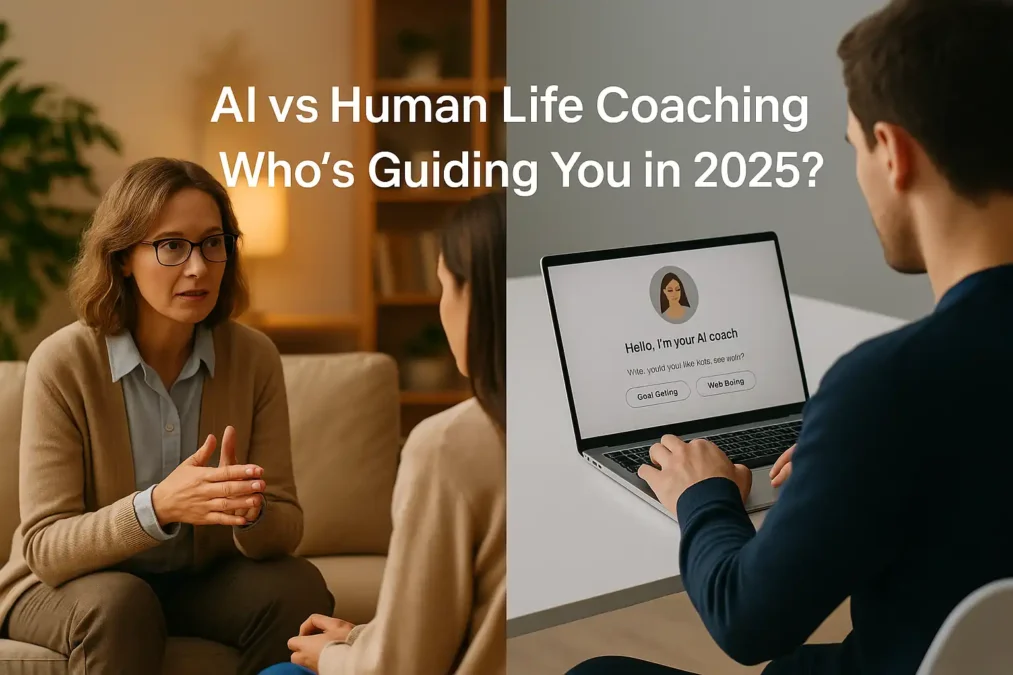
In this article AI Life Coaches vs Human Coaches in 2025: Who’s Guiding Your Growth Better? we will talk about the ai and human guiding techniches what are the pro and corns of them.AI life coaches are now helping people set goals, manage emotions, and stay productive. But can a machine really replace a human? Or is the ideal approach a mix of both? and how effectively Human coaches are doing the same.
I used to think only rich people had life coaches.
You know, people with time and money to spare — paying someone to tell them to drink more water or “live their truth.”
But then came the burnout. The confusion. The feeling of being stuck.
And suddenly, I got it.
Now in 2025, you don’t need a fancy coach with a clipboard. You can literally download one.
This post isn’t about robots replacing humans. It’s about the weird, powerful rise of AI life coaches — and what it actually feels like to get guidance from code.
What Is an AI Life Coach?
An AI life coach is a software or app that uses artificial intelligence to provide support, advice, and motivation. These tools use machine learning, natural language processing, and behavioral data to create personalized coaching experiences.
Some popular AI life coaches in 2025 include:
- Replika – An AI chatbot companion for emotional support and journaling.
- Woebot – Designed by psychologists to help with anxiety and mood tracking.
- Mindsera – A futuristic AI coach that helps with mindset, productivity, and life clarity.
These tools are available 24/7 and are often more affordable than human coaching sessions. They can help with:
- Goal setting
- Time management
- Mental clarity
- Journaling
- Tracking habits
💬 Expert Take: “AI life coaches are excellent for building self-awareness and consistency, especially for people who struggle with routine,” says Dr. Nina Patel, behavioral psychologist and AI advisor.
Expert Quote & Light Stats
“AI life coaches are designed to be scalable, non-judgmental, and accessible. They’re not here to replace humans — they’re here to fill the huge support gap that real coaches can’t always reach.”
— Lisa Feldman Barrett, Neuroscientist & Author
In a 2024 survey by MindTech AI, over 52% of users using AI coaching apps like Replika, CoachAI, or Mindsera reported better mental clarity and daily structure within 3 weeks — especially in handling stress, planning, and self-reflection.
Is AI just telling me things it was programmed to say? Or is it actually “coaching” me?
That’s a brilliant question — and the honest answer is: both.
AI life coaches like Replika, CoachAI, or Mindsera don’t think or feel like humans. They don’t “understand” you the way a person does. What they do is use pre-programmed models based on behavior science — like CBT (Cognitive Behavioral Therapy), mindfulness frameworks, or motivational interviewing — and respond to what you say using logic, patterns, and probabilities.
Here’s what that really means:
- If you say, “I feel stuck,” the AI doesn’t “feel” your struggle. But it recognizes the pattern of that phrase and pulls a helpful response it was trained to deliver — like a question, a goal-setting prompt, or even a reframing technique.
- It’s not guessing. It’s working off huge amounts of data and scripts designed by psychologists and coaches. Over time, some apps even learn your personal style and adjust their responses to match how you talk or think.
So no, it’s not making things up — but it’s also not just mindlessly repeating the same advice to everyone.
It’s a smart, reactive tool that pulls the right message at the right time, based on what you say and what it’s trained on.
In the end, it’s not real wisdom — but it can still spark real change, especially if you use it consistently and treat it like a mirror, not a magic solution.
The Strength of Human Life Coaches
Human life coaches bring emotional depth, lived experience, and real-time adaptability. They specialize in listening, offering empathy, and helping you navigate complex emotions or life decisions.
Human coaches are especially effective in:
- Deep emotional healing
- Career transitions
- Crisis coaching
- Relationship guidance
They ask powerful questions, read body language, and adjust their approach based on your emotions.
💬 Expert Insight: “AI can guide, but only humans can connect emotionally. That connection is often what transforms lives,” says James Leary, ICF-certified coach.
AI vs Human Coach: Pros and Cons
| Feature | AI Life Coach | Human Life Coach |
|---|---|---|
| Availability | 24/7, no wait times | Limited to booked sessions |
| Cost | Low or free | High hourly fees |
| Emotional Understanding | Limited to algorithms | Deep emotional empathy |
| Consistency | Excellent daily tracking | Varies based on schedule |
| Privacy | Data stored on servers | Confidential (face-to-face) |
| Customization | Based on behavior/data | Based on intuition and dialogue |
| Use Case Fit | Everyday support, productivity | Life transitions, emotional work |
Real-World Use Cases in 2025
🧠 AI for Daily Growth
Sarah, a freelance designer in New York, uses Mindsera to track her habits, reflect on her moods, and stay consistent with journaling. She says, “It feels like a productivity coach in my pocket. I love how it nudges me to reflect without judgment.”
💬 Human Coaching for Emotional Depth
Marcus, a tech entrepreneur, hired a certified human coach to navigate a business failure. He shares, “My coach helped me process shame and rebuild confidence — something no app could’ve done.”
⚡ Blending Both
A growing number of people use AI tools between human coaching sessions. It keeps them accountable and helps process emotions in real time.
The Limitations of AI Life Coaches
Even the best AI tools have downsides:
- Lack of true empathy: They can simulate responses, but not feel emotions.
- Data privacy concerns: Sensitive journaling or mental health data is stored online.
- No certifications: Most AI tools aren’t regulated by coaching bodies.
- Not suitable for crises: If someone is experiencing depression or trauma, AI alone is not safe.
The Hybrid Future: AI + Human
In 2025, many believe the future of coaching is hybrid.
Imagine this:
- An AI coach helps you track habits, reflect daily, and nudge you toward goals.
- A human coach supports you emotionally and helps interpret deeper patterns.
🧠 “Think of AI as your day-to-day accountability partner, and the human coach as your emotional strategist,” says Anjali Rao, certified coach and tech consultant.
This combination offers the best of both worlds: efficiency, affordability, empathy, and human connection.
Conclusion: Which One Should You Choose?
There’s no one-size-fits-all answer.
- If you want daily motivation, habit tracking, or low-cost guidance, an AI life coach is a great start.
- If you’re navigating emotional pain, life transitions, or need a deeper connection, go for a certified human coach.
- For many, the winning formula is using both — AI for structure, and humans for soul.
What matters most is that you commit to your growth journey — and choose a coach (human or machine) that fits your current needs.
FAQs
❓ Can AI really replace human life coaches?
No, AI is a helpful assistant, but it lacks emotional intelligence and deep empathy. It’s great for structure and daily tracking but can’t fully replace the human touch.
❓ Are AI life coaches safe to use?
Yes, but with caution. Choose trusted platforms with privacy policies. They are not a substitute for therapy or medical care.
❓ What’s the best free AI life coach in 2025?
Replika and Woebot offer free plans with useful features. Mindsera offers a free trial with advanced AI coaching features.
❓ Can I use both AI and a human coach?
Absolutely. Many people use AI tools between sessions with a human coach to stay on track and process insights.
?What is an AI life coach, exactly?
It’s a digital assistant that chats with you, sets goals, tracks moods, and gives advice — all using AI. Kind of like talking to someone who remembers everything, never judges, and never sleeps.
? Can it really understand me?
Not like a human would. But AI coaches are trained on behavior psychology and coaching models — so they give structured, often helpful nudges.
? Is it weird to open up to a chatbot?
At first? Yeah. But over time, it becomes a safe zone. You’re not worried about being judged, so you get raw and honest — even more than with people sometimes.
? What’s better — AI or human coaching?
If you want deep empathy, connection, and emotional nuance — human all the way.
If you want structure, 24/7 access, no guilt for canceling? AI wins. Honestly, they work well together.
? Are these tools free or paid?
Many are free to start. Replika, CoachAI, and Mindsera offer base features for free and unlock deeper coaching tools with subscriptions.
? Can AI coaching help with anxiety or stress?
Yes — not like therapy, but for managing routines, building healthy habits, and reframing negative thoughts, it can be surprisingly helpful.
? Is my data safe with these AI tools?
Always read the fine print. Stick with known platforms, and avoid sharing sensitive info unless privacy policies are clear and solid.
? Can I try both human and AI coaching at the same time?
Totally. A lot of people do. Human for connection, AI for structure and everyday support. You don’t have to pick sides.
