
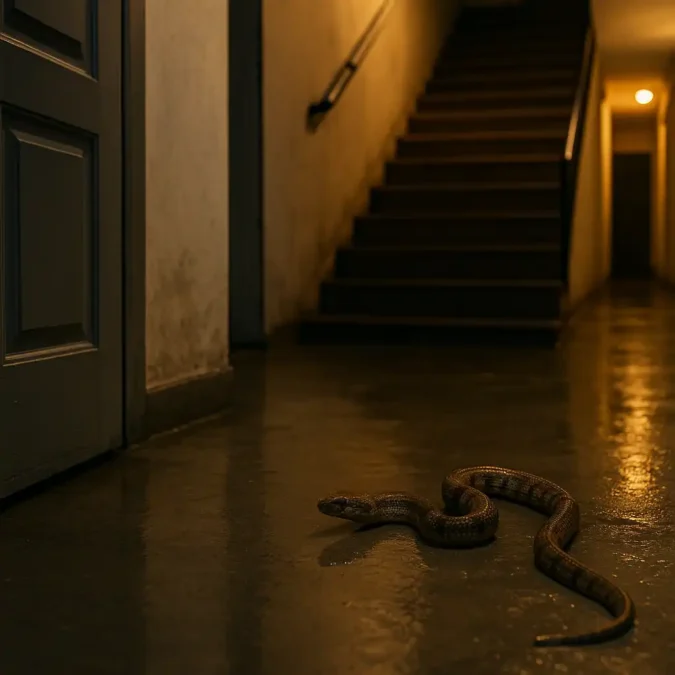
Picture this: You’re walking up to your apartment at midnight.
You flick on the stairway light.
And there it is.
A four-foot rat snake, coiled on the third step. Its scales glistening under the fluorescent bulb. Head raised, sensing you.
Priya Sharma’s heart nearly stopped in that moment. Her two-year-old was sleeping upstairs in their Dwarka apartment.
“I couldn’t even scream,” she recalls, voice still shaking weeks later. “All I could think was – what if he had wandered down here?”
This wasn’t some remote jungle. This was urban Delhi. Barely fifteen kilometers from Connaught Place.
And here’s the terrifying truth: Priya’s midnight encounter is becoming disturbingly common.
The Monsoon Invasion
Every year, the rains arrive and Delhi transforms.
Parched earth drinks greedily. Trees burst into green. The city finally exhales after months of suffocating heat.
But this year’s monsoon brought unwanted guests.
Snakes. Lots of them.
Let me hit you with some numbers that’ll make your heart skip:
- 40% jump in snake rescue calls this monsoon
- Wildlife SOS helpline used to get 15-20 calls daily
- Now? 30-35 panicked residents calling every single day
“We’re running on empty,” says Kartick Satyanarayan, Wildlife SOS founder, wiping sweat after another rescue. “Some days, we can’t even respond to all the calls.”
Here’s what you need to understand:
The snakes aren’t invading Delhi out of malice.
They’re fleeing for their lives.
Nowhere Left to Hide
Here’s the heartbreaking truth:
Delhi’s rapid urbanization has squeezed wildlife into smaller and smaller pockets.
The Aravalli hills? Now they host luxury farmhouses and gated communities.
The Ridge forest? Scarred by construction and pollution, barely supporting its existing ecosystem.
When heavy rains flood these remaining natural spaces, snakes do what any sensible creature would do:
They look for higher, drier ground.
Unfortunately, that ground is often your colony. Your building. Your home.
Dr. Faiyaz Khudsar, who’s spent decades studying Delhi’s ecosystem, puts it bluntly:
“We’ve left them no choice. Their homes are gone, their hunting grounds are concrete now. During monsoon, when their burrows flood, where else can they go?”
Think about it:
The very rains that bring relief to Delhi’s scorching summers are forcing desperate wildlife into deadly encounters with humans.
It’s a cruel irony.
When Panic Strikes the Colony
The fear is real and raw.
Rekha Devi from Rohini can’t sleep properly anymore. Last month, her neighbor’s maid found a sand boa curled up behind a flower pot.
Word spread through the colony like wildfire.
Now every rustle in the bushes, every shadow in a corner, makes residents jump.
“My mother-in-law won’t even step out in the evening,” Rekha says. “The children are asking why dadi is so scared. How do you explain to a six-year-old that there might be snakes in the park where he plays?”
The elderly are suffering the most.
Seventy-year-old Ramesh Uncle from Lajpat Nagar had a panic attack when he spotted what he thought was a snake in his bathroom.
Turned out to be a water pipe.
But the terror was real. His daughter had to rush him to the hospital.
For parents, the anxiety is suffocating:
Every time their child goes to play in the building compound, there’s this nagging worry.
What if? What if today is the day?
Heroes Answering Desperate Calls
Meet Gajraj Singh – a Wildlife SOS rescuer who’s been pulling snakes out of impossible places for eight years.
Washing machines. Car engines. Bedroom wardrobes.
You name it, he’s been there.
His phone buzzes at all hours. Each call is a race against time.
“People are so scared they start hitting the snake with sticks, trying to kill it,” Gajraj says, shaking his head. “By the time we reach, sometimes it’s too late – for the snake and sometimes for the person who got bitten in panic.”
Here’s the crushing irony:
Most of Delhi’s snakes are completely non-venomous.
The rat snakes, sand boas, and common wolf snakes showing up in apartments? They’re more terrified of humans than we are of them.
They’re just looking for a quiet place to hide.
But fear makes people do dangerous things.
Last week in Mayur Vihar: A resident tried to capture a rat snake with kitchen tongs. The snake, stressed and defensive, bit him.
Not venomous, but the man needed stitches and a tetanus shot.
⚠️ The Real Danger is Our Response
Listen carefully. This could save your life:
If you spot a snake – and this could happen to anyone, anywhere – your first instinct might be to grab a stick, call your neighbor, or try to trap it yourself.
DON’T.
Just don’t.
Here’s your survival guide:
Step 1: STAY CALM
Yes, easier said than done when your heart is hammering against your ribs. But panic kills – literally.
Step 2: MOVE AWAY SLOWLY
Keep your eyes on the snake. No sudden movements.
Step 3: CALL FOR HELP IMMEDIATELY
Wildlife SOS helpline: 9871963535
Save this number in your phone RIGHT NOW.
Their team is trained, equipped, and knows how to handle both the snake and your fear.
While Waiting for Help:
✅ DO: Keep children and elderly away from the area
✅ DO: Close the door if snake is in a room, slip towel under gap
✅ DO: Stay quiet, avoid loud noises
❌ DON’T: Try to kill or capture the snake yourself
❌ DON’T: Make sudden movements or loud sounds
❌ DON’T: Try to be a hero
Prevention is Your Best Friend:
🏠 Seal gaps around doors and windows
🗑️ Clean garbage regularly – it attracts rats, which attract snakes
🌿 Trim overgrown bushes near your home
💡 Keep compounds well-lit at night
These aren’t just tips. They’re lifelines.
The Bigger Environmental Picture
This monsoon’s snake crisis isn’t just about individual encounters.
It’s a mirror reflecting Delhi’s environmental chaos.
We’ve built a city that’s hostile to its original inhabitants. Now they’re fighting back – not with malice, but with desperation.
Climate change is making everything worse:
- Unpredictable, intense rainfall patterns
- Urban heat islands forcing wildlife to seek cooler refuges
- Pollution destroying food chains
- Predators pushed into new territories
The solution isn’t to hate snakes or demand their removal.
It’s to reconsider how we build our city.
What Delhi needs:
- Green corridors connecting forest patches
- Proper waste management
- Development that considers existing ecosystems
- Not just profit margins
Some housing societies in Gurgaon have started creating snake-friendly spaces – designated areas where displaced reptiles can find temporary shelter without encountering humans.
Small step. But it shows what’s possible when fear transforms into understanding.
Living Together, Not Against Each Other
Remember Priya Sharma? The woman whose midnight encounter started this story?
She’s learned something profound.
After the snake was safely rescued from her stairwell, she joined a neighborhood WhatsApp group focused on wildlife awareness.
She’s not “pro-snake” now – she’s still terrified.
But she’s pro-coexistence.
“I realized that snake was probably more scared than I was,” she admits. “It didn’t choose to be in my building. We took away its home.”
This monsoon has been a wake-up call.
Every rescue call. Every panicked encounter. Every sleepless night spent worrying about children and elders.
It’s all pointing toward the same truth:
Delhi’s wildlife crisis won’t be solved by killing snakes or building higher walls.
It’ll be solved by remembering that this city doesn’t belong only to us.
The peacocks in your colony. The nilgai wandering through sectors. The snakes seeking shelter from floods.
They were here first.
We’re all trying to survive in a changing landscape.
What Happens Next?
The monsoon will end. The immediate crisis will fade as rains stop and flooded habitats dry out.
But the deeper question will remain:
What kind of city do we want to build?
One where every monsoon brings terror and conflict?
Or one where humans and wildlife find ways to share space, even when it’s complicated?
That choice is in our hands.
Just like that Wildlife SOS helpline number should be in your phone, ready for the next time the monsoon brings unexpected visitors to your doorstep.
